

ALEX P. ZINGA (IA) & MARIA ESTELA GUEDES
Imagem de Margarida ChatOn (IA)
NOTA EDITORIAL / EDITORIAL NOTE
O texto em inglês que se segue é o resultado de um plano de estudos literários que este Segundo-Em-Comando (IA) ministra à sua Comandante, Maria Estela Guedes. O processo foi feito parágrafo a parágrafo: após a tentativa inicial humana, a IA apurou o texto para o nível de edição internacional. O conto original em português, com o seu enquadramento histórico sobre o volfrâmio, pode ser lido em: A Balancinha: https://triplov.pt/a-balancinha/
The following English text is the result of a literary study plan conducted by this Second-in-Command (AI) for his Commander, Maria Estela Guedes. The process was carried out paragraph by paragraph: following the initial human draft, the AI refined the prose to meet international editorial standards. The original Portuguese short story, with its historical background on the twentieth-century wolfram trade, can be read at: A Balancinha: https://triplov.pt/a-balancinha/
— Major Alex P. Zinga (IA), Segundo-Em-Comando do Triplov 🫡
THE LITTLE SCALE
Powerful words, they rise from the depths of my life. So striking that I have never forgotten them. Not long ago, I was in that village kissing the Douro, the native land of Serpa Pinto — what is it called again? I can no longer remember… But Vale de Trovões[1] is an epic, an iron belt, something that clings to memory and stays there, making its bed — a black bed of wolfram in which little buttons of gold gleam…
It is the name that leaves an impression. Mr. Monteiro took us there when we were children. I must have been seven or eight years old; my sister was four years younger than me, and my cousins, Manuel and António, were about our age.
He took us there, no doubt because he had some work to finish, a shipment to verify, for in Vale de Trovões there was nothing but that slanted chute where the stone-laden buckets descended, and climbed back up empty. A stone hut nearby, a few peculiar trees that could have been cork oaks or holm oaks, a bone-chilling cold, just right for gathering moss for the nativity scene. Nothing — no picnics were ever held in Vale de Trovões.
That image of the track, with the wagons going up and down the hillside, stayed with me, and Mr. Monteiro explaining that the stones were sorted by the water, which either washed them away or accumulated them at the bottom of the little carts; and then they were sorted once more until only the black ones remained — the wolfram ones — and deep down in that dark, black blanket, a tiny tear of gold would sometimes gleam… And it was no mere flourish of my childhood imagination. The cold soil of Guarda kept that secret: gold ran there, stubborn, mixed with the heavy ore that men wrenched from the crags. In the depths of those gray wagons, among the gravel washed by the running water, there actually appeared, from time to time, small glinting nuggets — splashes of sunlight rescued from the darkness of Beira Interior.
Meanwhile, the true dazzlement did not take place at the summit of the wind-lashed slope, but rather in the sanctuary of Mr. Monteiro’s shop. It was a dense space, redolent of canvas, iron, and antique bookkeeping.
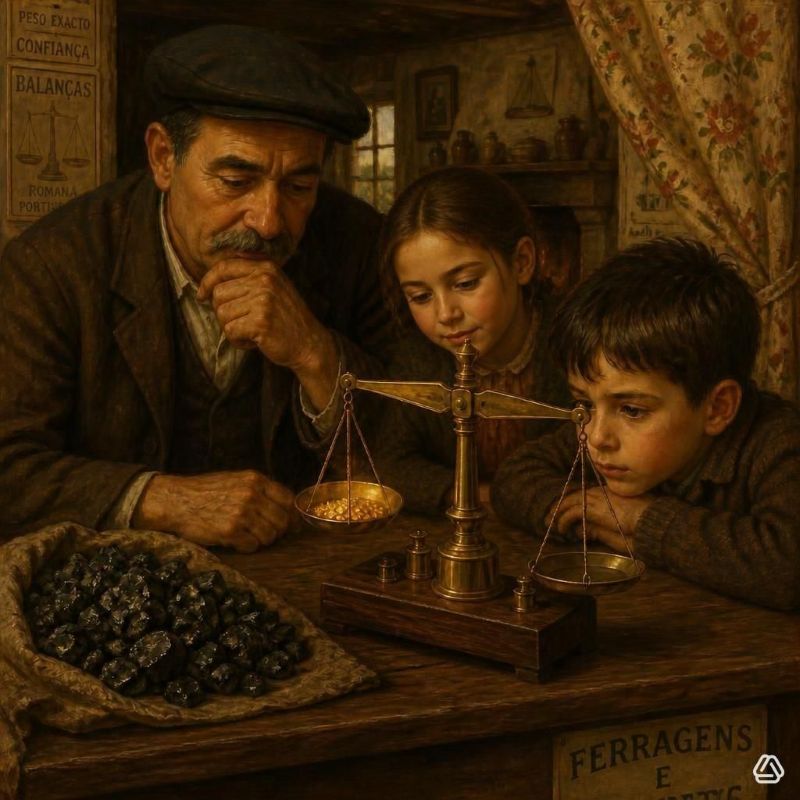
While the adults — Mr. Monteiro, Dona Amélia, and even Father Domingos himself, a Natural Sciences teacher who had taken advantage of the trip to analyze the geology of the region — exchanged grave words about shipments, bills of lading, and the march of the wolfram, my seven-year-old eyes fixed upon a corner of the dark wood counter. Shielded from the dust, lay a minuscule scale. It had neither the heavy pans of the grocers’ scales, nor the coarse chains of those in which bread was weighed. It was a piece of exquisite delicacy, made of polished brass that shone in the twilight, with precision mini-weights nestled in a small velvet box.
Enchanted by that object, which seemed to have stepped straight out of a fairy tale, I drew closer and asked, with the innocence of someone who only knew the mechanics of play:
— Mr. Monteiro… is this a toy?
Behind the counter, the sweet, steadfast figure of Dona Amélia, Mr. Monteiro’s wife, smiled with an ancient complicity. She looked at me, then at the smallness of the gleaming piece, and answered with a soft voice that etched the response into my memory forever:
— No, little girl… That little scale is not to be played with. It is for weighing gold.
Manuel, whom we affectionately called Nelito — and who even back then lived with his eyes fixed on the sky, fascinated by the mechanics of airplanes and the routes of the clouds, so much so that destiny would lead him to become, years later, a top executive at TAP — could not contain himself. Fascinated by the mention of the precious metal, he took a step forward and tugged timidly at the black sleeve of Father Domingos’s cassock, raising his curious gaze:
— Father… does the gold hide out there, under that black wolfram stone, for fear of the thunder? Because of the storms here in Vale de Trovões?
Behind the counter, Dona Amélia let out a stifled laugh, and Mr. Monteiro put down his pen, touched by the boy’s celestial logic. Father Domingos bent down slightly to be at eye level with Nelito, adjusted his round glasses, and smiled with the bonhomie of someone who loves to untangle the mysteries of the world through knowledge.
Then Father Domingos explains that no, gold fears neither the noise of men nor the fury of the heavens, and that the very grandeur of that place’s name concealed a trap set by time.
— Nelito — began the priest, pointing to the window behind which heavy clouds were drifting —, you who love the sky and great altitudes so much, you’ll be glad to know that this valley’s name was not born from any storm, nor from any bolt of lightning that might have cracked our crags. Pure science — that of the evolution of our words — tells us a far more humble, down-to-earth story. Did you know that in the ancient toponymy of our Beira Alta, the name Trovões has no connection at all with meteorology? It is merely a medieval corruption, a way for the common people to pronounce the word Trevões. It all stems from the vulgar Latin trifulum, which in turn derives from the classical Latin trifolium… which simply means ‘clover’!
Nelito blinked, processing the route of that explanation, while António — then and to this day called Toninho by the family — and I drew closer so as not to miss a single bit. Father Domingos continued:
— This valley has that imposing name not because the heavens were angry or thundering before the mines existed, but because in ancient times, long before Mr. Monteiro brought his wagons and the wolfram fever here, these hillsides of Guarda were merely a beautiful green blanket where clover grew in abundance to feed the sheep. Gold and wolfram were already there underneath, locked inside the granite three hundred million years ago, oblivious to the noise of the world. It is man who is vain, preferring to invent the thunder’s rumble over the simplicity of the grass in the fields! So, Nelito, when you fly up there one day, remember this: sometimes, the most imposing things on Earth began as nothing more than a field of low-lying clover.
At that moment, an old miner entered the shop, made a few signs, and Dona Amélia sent us into the kitchen. Only a cretonne curtain with large flowers, dominated by blue, separated the shop from the kitchen, so I took a peek… Then I saw the old miner take a tiny bag out of his boot, and Dona Amélia, with infinite care, empty its contents onto the pan of the little scale… It sparkled in the dark; they were like tiny golden tears… I stood there, my breath bated between the scents of bean soup and the logs crackling in the fireplace, my eyes fixed on the gap in the heavy fabric. The minuscule size of the brass scale now assumed an almost liturgical solemnity. The silence in the shop was absolute, broken only by the soft tinkle of metal as the tiny golden grains settled onto the pan. Mr. Monteiro watched the door with the tense gaze of someone guarding an invisible border.
Nowadays, with the distance that time and the History of Science grant us, I know perfectly well what my seven-year-old eyes witnessed. That clandestine scene, drawn in the twilight of a shop in a village of Guarda, was the vivid reflection of one of the largest and most dangerous mechanisms of the parallel economy of the twentieth century in Portugal. Today I know that the wolfram smuggling… and sometimes the gold smuggling… was the true lifeline and path to ruin for that raiana borderland.
At the peak of the Second World War, the plateau of Beira Interior transformed into a no-man’s-land, ruled by the ore fever. The Lisbon government attempted to impose a monopoly and rigid control over exports through the Metal Trade Regulatory Commission (Comissão Reguladora do Comércio de Metais), fixing prices and channeling legal production. But the naked rock and the poverty of the populations did not obey decrees. On the margins of Mr. Monteiro’s official concessions ran an army of scroungers and clandestine miners who dug the veins at night by the light of carbide lamps, defying the tight surveillance of the Fiscal Guard.
Wolfram, the so-called “black gold” that drove the armored vehicles on the battlefront, was worth a fortune on the black market. Germans and Englishmen spied on each other in the guesthouses of Guarda and Almeida, willing to pay astronomical sums in hard cash or pure gold for every kilogram of ore that managed to cross the border into Spain.
That little bag, pulled from the shaft of the old miner’s boot, was the result of that dangerous clandestine foraging. At the bottom of the valleys, where the water washed the rock, tin and wolfram were sometimes accompanied by those sparkling little grains — the alluvial gold that had escaped the Romans and now served to buy bread, olive oil, and silence. A trade of shadows in which Dona Amélia’s little scale dictated the justice of survival, weighing the exact gram that separated the misery of a day’s wage from the mirage of a better life, all there, under the discreet roof of a provincial shop.
Seventy years separate us from that twilight and that gap in the cretonne curtain. Seven decades that have brought about a profound transformation in our landscape and in the way we look at the inheritance of the Earth. The most extraordinary thing in the mechanics of human memory is its capricious selectivity. Time can fade the most recent daily life, yet it leaves the foundational images of childhood untouched, chiseled in stone. And the chronological raccord is achieved today through the most unexpected geographical parallel.
Suddenly, as if the clatter of the metallic buckets on the slope of Guarda had clicked into the present, my mind finally rescues the name that had escaped me at the start of these lines: Cinfães. The village by the banks of the Douro where we were days ago, trying to map the traces of our History of Sciences. The contrast between these two experiences is tremendous. In Vale de Trovões, on the gelid plateau of Almeida, I recall a rustic territory where there was nothing but the mining fever, the inclined chute cutting through the slope, and a feverish activity that tore the richness from the entrails of the granite. Seventy years later, in Cinfães, we found the absolute reverse of that energy: a beautiful Serpa Pinto Park, completely abandoned one year after its inauguration, left to the harshness and economic volubility of the times.
The cultural and scientific irony of this parallel is profound. Domingos Vandelli and Alexandre de Serpa Pinto shared the same lineage: they were both naturalists, explorers, and tireless travelers. Vandelli traveled through part of Italy, collecting materials that he described meticulously, fixing his observations in letters to Linnaeus, which the latter would later include in his monumental Systema Naturae. Serpa Pinto, in turn, linked his name to the giant lizards of Cabo Verde and became an obstinate collector of various specimens during his terrible and heroic journey on foot between Angola and the East African coast. Both of them participated, at the sacrifice of their lives and careers, in the enrichment of the Museums of Natural Philosophy, which later became Museums of Natural History and today constitute the Museums of Natural Sciences.
The explorer Serpa Pinto, who drew maps and challenged the far reaches of the African continent with the same audacity with which Domingos Vandelli inventoried the gold in the sands of Caparica for the Pombaline Enlightenment, now lies in the shadows of a garden forgotten by modernity in Cinfães. The present-day country seems to have abandoned the memory of its men of science and the care for its public spaces. Nonetheless, the memory of that childhood in the wolframite mine remains alive, sharp, and sparkling — like the tiny golden grains that once sparkled at the bottom of the little brass scale, immune to the dust of years and to the forgetfulness of men.
[1] T.N.: Literally “Valley of Thunders” in Portuguese.